
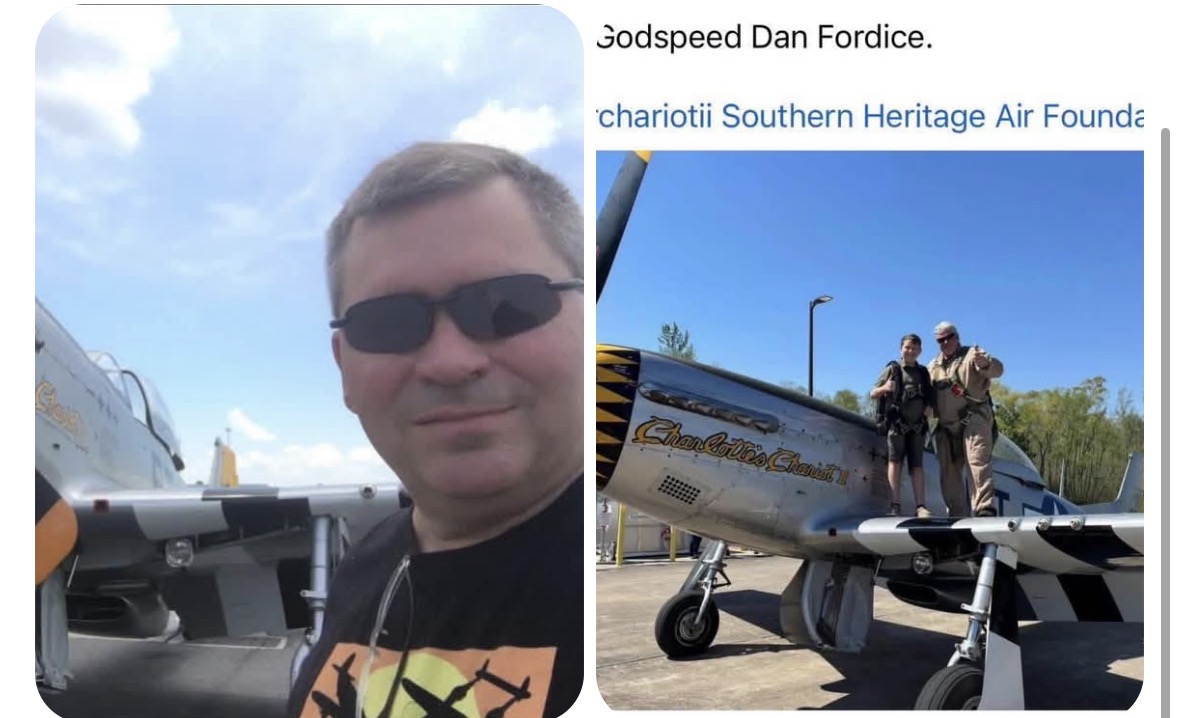
Dan Fordice Killed in Crash of Historic F-51D Mustang “Charlotte’s Chariot II” (N251CS) at Tallulah Vicksburg Regional Airport, LA: Pilot Dies in May 12, 2026 Warbird Accident.
TALLULAH, LA – Tuesday, May 12, 2026 – A deep and profound sorrow has settled over the aviation world following the tragic loss of pilot Dan Fordice, who was killed when the historic North American F-51D Mustang known as “Charlotte’s Chariot II” crashed at the Tallulah Vicksburg Regional Airport. The accident, which occurred just before 3:30 p.m. local time, has left family members, fellow aviators, warbird enthusiasts, and the broader community grappling with an unimaginable loss.
According to initial reports from local authorities and the Federal Aviation Administration (FAA), the aircraft—registered as N251CS—was involved in a fatal incident on airport grounds. Officials confirmed that Dan Fordice was the sole occupant of the aircraft. Tragically, there were no survivors.
The crash has sent shockwaves through the tight-knit warbird community, where both the pilot and the aircraft were revered as living connections to a bygone era of military aviation history. For those who knew him, Dan Fordice was not merely a pilot; he was a steward of history, a passionate advocate for preserving the legacy of WWII-era fighter planes, and a man whose love for flight was matched only by his generosity of spirit.
The Aircraft: “Charlotte’s Chariot II” – A Living Legend
The aircraft involved in the crash, “Charlotte’s Chariot II,” was no ordinary plane. The North American F-51D Mustang (the post-war designation for the legendary P-51D Mustang) is widely regarded as one of the most iconic fighter aircraft ever built. Known for its sleek lines, powerful Rolls-Royce Merlin engine, and unmatched performance in World War II and the Korean War, the Mustang has become a crown jewel of the warbird collector community.
Registered as N251CS, “Charlotte’s Chariot II” was a meticulously maintained and historically significant example of this legendary fighter. The aircraft was a familiar and beloved sight at airshows and aviation gatherings across the southern United States, where its distinctive roar and gleaming silver exterior drew crowds of admirers young and old.
Aviation enthusiasts who followed the aircraft’s history note that “Charlotte’s Chariot II” was more than a museum piece—it was a fully operational, living piece of history. Fordice had spent countless hours and significant resources preserving and maintaining the aircraft, ensuring that future generations could witness the Mustang’s raw power and elegance firsthand.
“This wasn’t just a plane to Dan,” said fellow warbird pilot and longtime friend, Colonel (Ret.) James H. “Hutch” Hutchinson, speaking by phone from his home in Texas. “That aircraft was his passion, his responsibility, and his joy. He understood that he was a temporary caretaker of something much larger than himself. He took that duty incredibly seriously.”
The Pilot: Dan Fordice – A Life Defined by Flight
Dan Fordice was not a household name to the general public, but within the warbird and general aviation communities, he was widely respected as an accomplished, skilled, and deeply committed pilot. His experience spanned decades, and his knowledge of vintage military aircraft was considered encyclopedic by those who flew with him.
Friends and colleagues describe Fordice as a man who carried himself with humility despite his extraordinary talents. “Dan could fly circles around most pilots half his age, but you would never hear him brag about it,” said longtime aviation partner and crew chief, Michael “Mick” O’Brien. “He was the kind of guy who would spend hours after a flight talking to a ten-year-old kid who was curious about the plane, answering every question with patience and excitement. He loved sharing aviation with anyone who would listen.”
Fordice’s connection to “Charlotte’s Chariot II” ran deep. He had been involved with the aircraft for years, both as its pilot and as its primary caretaker. The name “Charlotte’s Chariot II” held personal significance, though family members have not yet disclosed the full story behind the name pending privacy considerations. What is known is that Fordice treated the aircraft as a member of his own family—with reverence, care, and an unshakable sense of duty.
Beyond his flying career, Fordice was described as a devoted family man. He is survived by his wife, children, and extended family, all of whom have requested privacy during this unimaginably difficult time. In a brief statement released through a family spokesperson, they wrote: “Dan lived for the skies. He left this earth doing what he loved most. We are heartbroken, but we are also grateful for the years we had with him and for the incredible community that has wrapped its arms around us.”
The Crash: What Happened at Tallulah Vicksburg Regional Airport?
The accident occurred at approximately 3:30 p.m. local time on May 12, 2026, at the Tallulah Vicksburg Regional Airport (KTVR), located in Madison Parish, Louisiana, near the Mississippi River. The airport serves the communities of Tallulah, Louisiana, and Vicksburg, Mississippi, and is a popular stop for general aviation and corporate aircraft, as well as a hub for warbird operations in the region.
According to preliminary reports, the F-51D Mustang was the only aircraft involved in the incident. Witnesses on the ground reported seeing the aircraft in distress moments before the crash, though the exact sequence of events remains under active investigation by the FAA and the National Transportation Safety Board (NTSB).
Emergency responders arrived at the scene within minutes, but the crash was unsurvivable. Authorities confirmed that Dan Fordice was pronounced deceased at the scene. No other injuries or damage to other aircraft or structures were reported.
The NTSB has dispatched a team of aviation accident investigators to the site. Their work will include examining the wreckage for mechanical failures, reviewing maintenance records, analyzing weather conditions at the time of the flight, and interviewing witnesses. A preliminary report is typically released within two to three weeks, while a final determination of probable cause may take 12 to 24 months.
Early speculation within the aviation community has focused on the unique challenges of operating vintage warbirds. Unlike modern aircraft with redundant systems and computerized flight controls, the F-51D Mustang requires constant hands-on flying and an intimate understanding of its quirks and limitations. Even experienced pilots like Fordice face risks every time they take to the skies in these aging warriors.
The Warbird Community: A Family United in Grief
The loss of Dan Fordice and “Charlotte’s Chariot II” has been felt deeply across the warbird community, a close-knit group of pilots, mechanics, historians, and enthusiasts dedicated to preserving and flying historic military aircraft. This is a community that understands the risks intimately—but also one that understands the profound importance of keeping history alive.
“Every time we strap into a warbird, we know what’s at stake,” said warbird pilot and airshow performer, Amanda “Ace” Reynolds. “These planes are 70, 80, 90 years old. Things can go wrong. But we fly them because they deserve to be seen, heard, and remembered. Dan knew that better than anyone. He wasn’t reckless. He was respectful. And that makes this loss even harder to process.”
Social media has been flooded with tributes from across the country. The hashtags #DanFordice, #CharlottesChariotII, and #RestInPeaceMustang have trended within aviation circles, accompanied by photos of Fordice smiling beside his beloved aircraft, videos of the Mustang performing at airshows, and heartfelt messages from those whose lives he touched.
“Dan was the first person to welcome me into the warbird world,” wrote a young aviation enthusiast on a popular flying forum. “I was 16, scared, and didn’t know anything about Mustangs. He spent an entire afternoon showing me around ‘Charlotte’s Chariot II,’ explaining every switch and gauge. He didn’t have to do that. He wanted to. That’s who he was.”
The Risks of Flying History
The crash serves as a solemn reminder of the inherent dangers of operating vintage military aircraft. Unlike modern production aircraft that benefit from decades of engineering refinement, computer modeling, and stringent regulatory oversight, warbirds are aging machines often operating on original or rebuilt components that were never designed for six or seven decades of service.
Maintaining a flyable warbird requires an immense investment of time, money, and expertise. Engines must be overhauled regularly, airframes must be inspected for corrosion and metal fatigue, and replacement parts—many of which are no longer manufactured—must be sourced from a dwindling supply or fabricated by specialty shops. Even with the best maintenance, mechanical failures remain a persistent risk.
Pilots who fly warbirds must possess not only exceptional stick-and-rudder skills but also deep systems knowledge and the ability to make split-second decisions when something goes wrong. Fordice had all of those qualities in abundance—which is why his loss has been particularly shocking to those who knew him.
“Dan was as careful and competent as they come,” said aviation safety consultant and former NTSB investigator, Robert “Bob” Langley. “If something went wrong on that flight, it wasn’t because of carelessness or lack of skill. It’s a reminder that even the best pilots, flying the best-maintained aircraft, can face circumstances beyond their control. Aviation is unforgiving.”
Honoring a Legacy
As investigations continue, the focus for many has shifted to honoring Dan Fordice’s memory and ensuring that his legacy—and the legacy of “Charlotte’s Chariot II”—endures. Fellow pilots have discussed the possibility of establishing a scholarship in Fordice’s name to support young aviators interested in warbird restoration and flight. Others have proposed creating a permanent memorial at the Tallulah Vicksburg Regional Airport.
A memorial flyover is being planned by fellow warbird pilots, who intend to honor Fordice by flying a missing man formation at an upcoming aviation event. The missing man formation—a time-honored tradition in which one aircraft breaks away from the formation and climbs toward the heavens—is one of the most emotional tributes in all of aviation.
“Dan would be embarrassed by all the attention,” his wife said with a sad smile in a statement shared by a family friend. “He never wanted to be the center of anything. But he deserves this. He gave so much to so many. It’s our turn to give something back.”
Final Farewell
The skies over Tallulah, Louisiana, and the broader aviation world feel emptier this week. The roar of “Charlotte’s Chariot II” has been silenced. The steady hands of Dan Fordice will never again grasp a control yoke. But those who knew him—and those who never had the privilege but will still learn his story—will carry his memory forward.
A private funeral service is being planned for family and close friends. A public celebration of life is expected to be announced in the coming weeks, likely at an airfield where Dan spent so many of his happiest hours.
Until then, the tributes continue. Candles are lit. Toasts are raised. Stories are shared through tears and laughter. And a Mustang—that beautiful, roaring, defiant piece of history—flies forever in the hearts of those who loved her and the man who flew her.
Rest in peace, Dan Fordice.
Rest in peace, “Charlotte’s Chariot II.”
You will be deeply missed, but never forgotten. Your legacy will continue to soar.
Leave a Reply